Paul Simon by Robert Hilburn
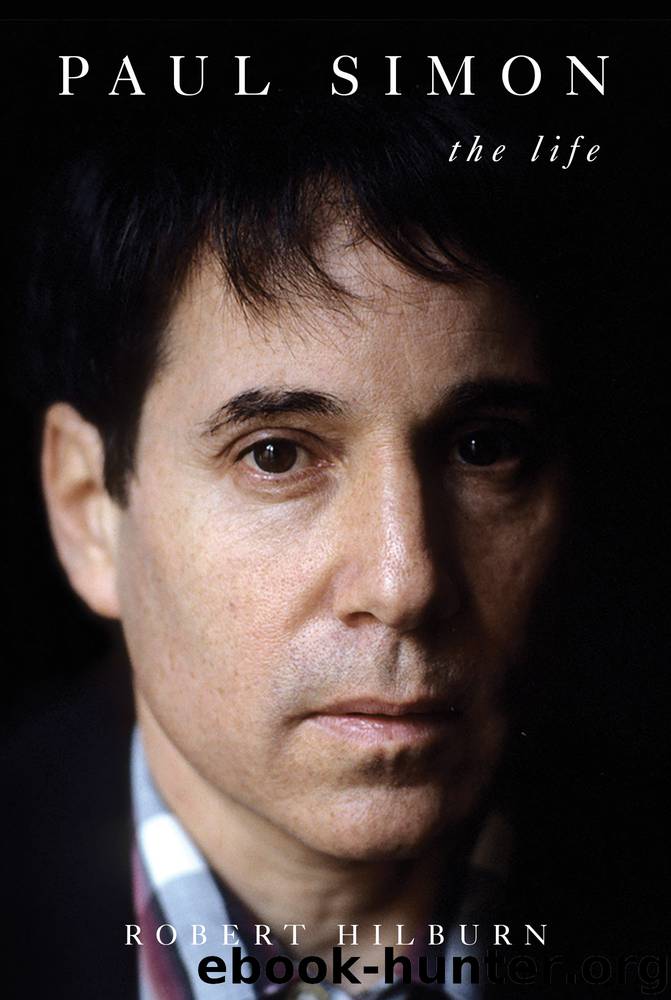
Author:Robert Hilburn
Language: eng
Format: epub
Publisher: Simon & Schuster
* * *
Unable to shake his latest bout of writer’s block in the spring of 1981, Simon, on a friend’s recommendation, contacted Dr. Rod Gorney, a Los Angeles psychiatrist whose father, Jay Gorney, was a noted songwriter who cowrote the Depression-era hit “Brother, Can You Spare a Dime?”; encouraged by their phone conversation, Simon flew across the country and went directly to the psychiatrist’s house.
“I’m here,” he told the psychiatrist, “because, given all the facts of my life—given the fact that I’m young, and I’m in good health, and I’m famous; that I have talent, I have money—given all these facts, I want to know why I’m unhappy. I can’t write anymore. I have a serious writer’s block, and this is the first time I can’t seem to overcome it.” Simon also talked about his troubles with Carrie, including their constant breakups. Faced with a problem that made them uncomfortable, they were inclined to say, “Hey, I don’t need this.” They were, Simon said, spoiled because they were both used to being the center of attention. At the end of the visit, Gorney told Simon that he felt further sessions would be useful. He also pointed to a guitar in his living room and urged Simon to take it to his hotel and try to express his feelings in a song.
Simon was so drained that night he didn’t even open the guitar case. Besides, he told Gorney when they got back together the next day, it takes him months to write a song. Gorney said he understood, but again suggested that Simon try to write a song. Back in the hotel that second evening, Simon did start writing. He came up with part of the melody and some early words for a song, “Allergies,” that eventually included these lines:
I go to a famous physician
I sleep in a local hotel
From what I can see of the people like me
We get better
But we never get well
Gradually, Simon recalled, the conversations with Gorney turned more philosophical. “My problem,” Simon told him, “is that I really don’t see what difference it makes if I write or don’t write.” The psychiatrist got him to admit that a song like “Bridge Over Troubled Water” made a difference in people’s lives, and he encouraged Simon to write more songs that made a difference. Simon returned to New York. He finished “Allergies” and began working on other songs for a new album; mostly personal songs about relationships. The talks with Gorney didn’t erase all of Simon’s troubles, by any means, but they helped him reconnect with his songwriting. As Carrie said, “When Paul had problems, he would often go into his music. Music was a very good friend to him.”
He played “Allergies” for Carrie in New York, and she was touched. “As soon as I heard the words—‘My heart is allergic to the women I love, it’s changing the shape of my face’—I knew the song was about me,” she said. “But I didn’t take it personally. I was honored.
Download
This site does not store any files on its server. We only index and link to content provided by other sites. Please contact the content providers to delete copyright contents if any and email us, we'll remove relevant links or contents immediately.
Cecilia; Or, Memoirs of an Heiress — Volume 2 by Fanny Burney(32010)
Cecilia; Or, Memoirs of an Heiress — Volume 3 by Fanny Burney(31996)
Fanny Burney by Claire Harman(26660)
We're Going to Need More Wine by Gabrielle Union(19108)
Plagued by Fire by Paul Hendrickson(17462)
All the Missing Girls by Megan Miranda(16317)
Cat's cradle by Kurt Vonnegut(15441)
For the Love of Europe by Rick Steves(14579)
Bombshells: Glamour Girls of a Lifetime by Sullivan Steve(14136)
Leonardo da Vinci by Walter Isaacson(13411)
4 3 2 1: A Novel by Paul Auster(12513)
The remains of the day by Kazuo Ishiguro(9085)
Adultolescence by Gabbie Hanna(8962)
Note to Self by Connor Franta(7701)
Diary of a Player by Brad Paisley(7648)
Giovanni's Room by James Baldwin(7436)
What Does This Button Do? by Bruce Dickinson(6262)
Ego Is the Enemy by Ryan Holiday(5527)
Born a Crime by Trevor Noah(5431)
